

Career & Business Coaching Blog for Creatives & Entrepreneurs.
Inspiration, guidance, and practical strategies for multi-passionate professionals who refuse to choose just one thing.

Complete Portfolio Career Guide: Design a Professional Life That Fits You
A portfolio career (or polygamous career, as I have heard it being called lately) is a thoughtfully designed professional lifestyle that combines multiple income streams, rather than relying on a single full-time job. For creative generalists who notoriously resist specialization, this approach allows you to pursue multiple passions simultaneously while building financial stability and freedom. Here is everything you need to know to build yours.
This guide is designed for multi-passionate professionals, multipotentialites, and "scanners/slashers" who feel constrained by traditional career paths.
What you will learn:
The 5 specific models I use in my own portfolio career and with clients to help them structure a successful portfolio career.
A proven 5-step framework to transition without financial recklessness.
How to find the "glue" that connects your seemingly random interests.
As a career coach for creative generalists, I have helped hundreds of clients move from feeling "scattered" to building profitable, sustainable careers that honor their many interests and passions.
What Is a Portfolio Career?
A portfolio career intentionally combines multiple income streams. It's not juggling random gigs or endlessly trying to make ends meet, but a thoughtfully designed collection of 2-5 roles that create financial stability and fulfillment.
Unlike a chaotic "side hustle" life where you are reacting to financial panic, a portfolio career is something you build. You choose the pieces. You design how they fit together. You decide when to scale one up or down.
This path is best suited for creative generalists, multipotentialites, and polymaths: people who have a wide range of interests across seemingly unrelated domains and experience boredom in single-track roles.
Why is this career path exploding right now?
The Normalization of the Gig Economy: By 2027, freelance and contract work is projected to make up the majority of the US workforce. The infrastructure to support multiple income streams has never been better.
AI and Automation: As AI handles specialized, repetitive tasks, the ability to connect dots across different fields (a core generalist skill) is becoming a premium asset.
The Craving for Autonomy: More people are opting out of the "golden handcuffs" of corporate life in favor of ownership and autonomy. I see it in my coaching practice every day. A portfolio career offers diversification; if one income stream isn't working out, you have others to lean on.
Key takeaway: This is about intentional design. You are building a diversified investment portfolio, but instead of stocks, you are investing in your skills.
Is a Portfolio Career Right for You? 10 Signs
You are likely a good fit for a portfolio career if these 10 traits resonate with you:
You have multiple passions you refuse to give up. The idea of "picking one thing" feels like a physical loss to you. As soon as you have made a decision, a sense of panic sets in about all the doors you are closing. If this is you, I see you.
Boredom hits fast. You master the 80% of a job quickly, and once the learning curve flattens, you are ready to quit. Now that you've learned what you came to learn, the 20% left feels like useless repetition.
You've been called "scattered," but that's not you; you just have a lot of energy for different things. You NEED variety as much as you need oxygen.
You are a quick learner. You can dive into a new domain and become proficient faster than most specialists. This means that when something is hard, it's not always easy for you to stick with it.
Standard job descriptions feel suffocating. You often feel compelled to cut off parts of yourself to fit into a professional box. You feel undervalued and your talents underutilised.
You see eclectic connections everywhere. You naturally apply insights from one field (such as gardening) to a completely different one (such as software design). You have gut feelings about people you need to introduce to one another, and you map thoughts and ideas over unrelated disciplines.
Your resume is "unconventional" to say the least. You have multiple career changes or major shifts in your history. You feel you didn't "choose" your career; it was luck and other people.
Variety energizes you. Switching tasks doesn't drain you; it actually wakes your brain up. You might have been told that you switch too much and too quickly between jobs or subjects.
It is hard to explain what you do. When people ask at dinner parties, you hesitate or give a different answer every time. Or you overwhelm them with everything you are and do, because you don't want to leave anything out.
You believe diversity is an asset. You know deep down that your range is a superpower, not a liability. You just don't know how to make it work in your favor.
If 7 or more of these resonate, a portfolio career likely fits your unique nature.
Reframing the "Jack of All Trades"
Society often shames generalists with the quote "Jack of all trades, master of none." But the full quote is actually: "A jack of all trades is a master of none, but oftentimes better than a master of one."
History is full of successful portfolio careerists. Leonardo da Vinci wasn't just a painter; he was an engineer, anatomist, and architect. Benjamin Franklin was a writer, diplomat, scientist, and inventor.
Another remarkable generalist from history is Hedy Lamarr, a Hollywood actress and inventor. While celebrated for her on-screen performances, she also co-developed a frequency-hopping communication system during World War II, laying the groundwork for modern technologies such as Wi-Fi and Bluetooth.
What I like about Lamarr's story is that her pursuit of multiple passions is a great example of how our generalist interests drive groundbreaking innovation and lasting impact.
What all of these generalists have in common? They didn't succeed despite their wide array of interests; they succeeded because of it. You're in good company.
Take the Creative Generalist Quiz
5 Portfolio Career Models
Based on my work with generalists over a decade and my own varied career, I've identified 5 core portfolio career structures. You'll probably shift between these over time, so treat them as flexible starting points, not fixed labels. Also, choose the model that best fits your financial needs, risk tolerance, and, most importantly, your primary professional goals. You can always change your mind later (yes, truly!).
1. Main & Sides (The Conductor)
Structure: One core job or contract covers most expenses; 1–3 "sides" provide creative outlets and secondary income (typically 60–90% of the main, with the rest from the sides).
Best for: Anyone who values security but craves creative variety. Great for those with financial obligations, people starting their multi-passionate journey, or anyone needing a predictable paycheck.
Income Timeline: The main provides immediate, consistent income. Sides may take 6–12 months to grow, but there’s no pressure for them to "match" your main source.
Time Management: The main dictates most of your schedule (e.g., a 9–5). Sides slot into weekends, evenings, or blocked days off. Requires strong boundaries to protect creative time.
Pros: High stability. Low risk. Lets you experiment and build skills safely. Clear professional identity.
Cons: Can feel like working two jobs. Burnout is possible if you don’t protect your time fiercely. Sides may struggle for your attention or feel less “serious.”
First Steps: Secure or optimize your main. Choose just one side to start. Block out 3–5 hours weekly - non-negotiable - for that project.
2. Equal Parts (The Tightrope Walker)
Structure: Multiple (typically 2–3) core income streams, each at 30–50% of your income/time.
Best for: Thrives on variety and context-switching. Skilled at juggling. Ideal for those wanting to be fully multi-passionate in their work.
Income Timeline: Takes time, often 1–2 years, to build multiple stable streams. Many start with the Main & Sides model, then grow a side into a second (or third) main.
Time Management: You control your schedule: theme days, split days, or even alternating weeks. Requires strong organizational systems.
Pros: Highly diversified risk. Maximum variety. True freedom to explore multiple talents.
Cons: Hard to explain to others. Risk of looking “scattered.” Must market/manage several streams at once.
First Steps: Identify your top 2–3 interests with earning potential. Build one for stability, then layer in the next. Craft a simple message that connects your slashes.
3. Seasonal Rotation (The Choreographer)
Structure: Distinct “seasons” (e.g., Q1–Q2 for one focus; Q3 for another; Q4 for downtime or planning).
Best for: Those who value immersive focus, avoid context switching, or whose work aligns with seasonal demand (tourism, teaching, tax preparation).
Income Timeline: Often “lumpy.” You might earn 80% of your annual income in half the year, so saving for leaner months is key.
Time Management: You sprint, then rest. Your year is planned in blocks, not weeks.
Pros: Lets you go deep. True work-life balance (real downtime!).
Cons: Income/energy swings. Needs rigorous financial planning and self-awareness.
First Steps: Map your year by energy, season, or opportunity. Budget to smooth out lean periods.
4. Passion + Good Enough Job (The Patron)
Structure: Income: 80–90% from job; Fulfillment: 80–90% from passion.
Best for: Artists, musicians, or anyone building a creative pursuit that isn’t yet profitable, but refuses to give up on it.
Income Timeline: The job delivers steady income. The passion side may or may not ramp up financially over time, and that’s okay.
Time Management: The job is stable and contained (ideally not mentally draining). Reserve your creative or energetic hours (evenings, mornings, weekends) for what really lights you up.
Pros: Freedom to build your dream without financial panic. Job doesn’t define you, your passion does.
Cons: Passion side can feel “less real” if not making money yet. Risk of job draining your time/energy if not chosen carefully.
First Steps: Find a day job that leaves you with energy and isn’t toxic. Give your passion protected time every week, no guilt.
5. Exit Plan (The Grand Finale)
Structure: Starts with 90% of income/time in your current job and 10% in your new passion/project. Gradually shifts, over months or a couple of years, until you reach 0% traditional, 100% new.
Best for: Anyone ready to leap but needing a proof of concept before going all in. Great for corporate careerists, midlife shifters, or side-hustlers planning their exit.
Income Timeline: The “exit” can take 1–3 years, depending on your savings, risk, and how your passion side grows.
Time Management: Balance your “main” for security and allocate protected time for building the new thing. Eventually, scale back the old as the new ramps up.
Pros: Lower risk than a cold-turkey exit. Time to test, learn, and fail before fully committing.
Cons: Splits your focus; takes patience and discipline.
First Steps: Set clear milestones to move from 90/10 to 50/50, then to 0/100. Celebrate each step forward.
These models are the ones I have seen repeatedly in my work and in my own professional life. However, they are just launchpads. Start where you are, and evolve as you grow. Only you know what kind of portfolio career will work for you, and that is precisely the point!
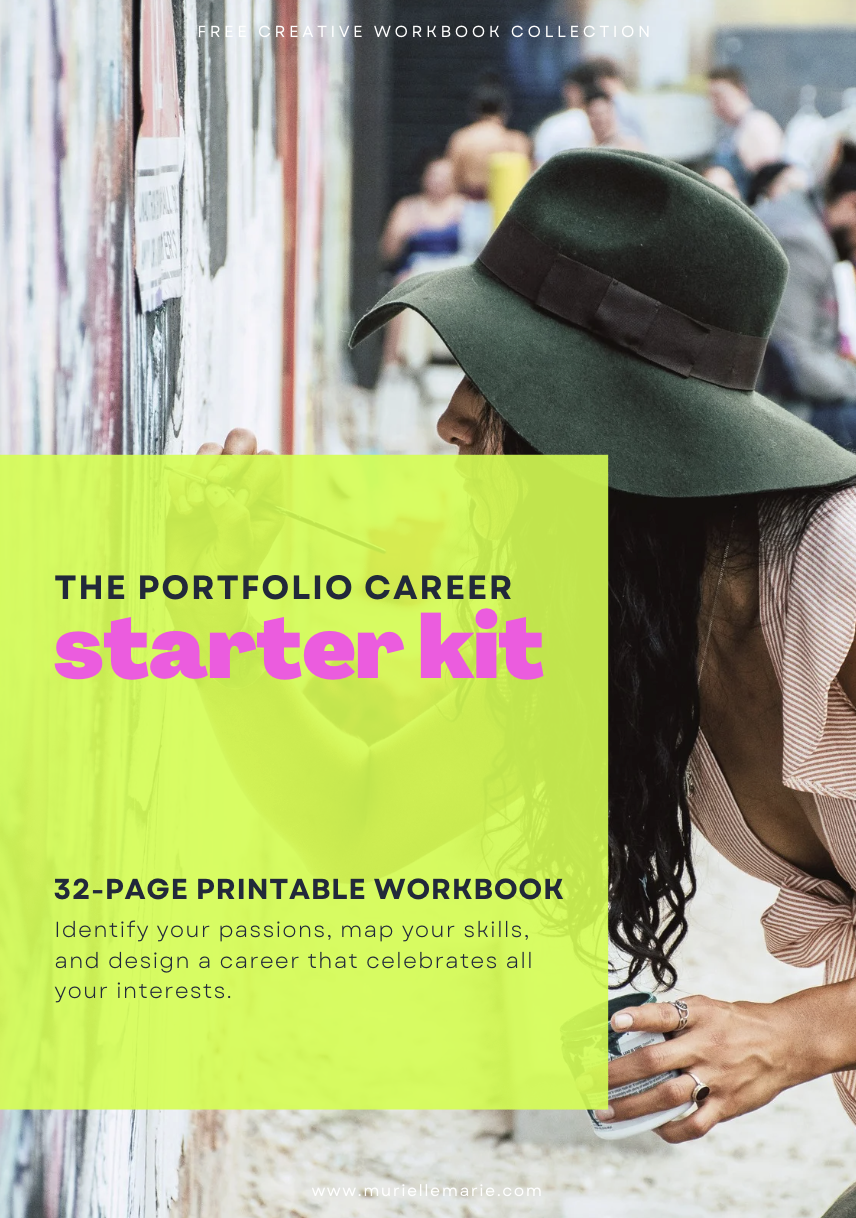
Download the free Portfolio Starter Kit if you want to dive deeper
5-Step Framework to Design a Sustainable Portfolio Career
Here is the proven framework I use with clients to help them get started with sustainable portfolio careers that don't lead to burnout.
Step 1: Audit Your Interests
Before you strategize, you must see the full picture. List everything you love, everything you are good at, and everything you are curious about. Don't edit yet. Include professional skills (coding, writing) and "hobbies" (baking, interior design). Look for patterns. Often, the things we dismiss as hobbies are actually viable income streams waiting to be packaged correctly.
Step 2: Find Your "Glue"
This is the most critical step for positioning. What connects your many interests? If you're a coder who loves baking, your glue might be "systems." If you're a writer who loves therapy, your glue might be "narrative healing." It's the best starting point. It explains why you do these different things.
Step 3: Test Market Demand
Now, validate. Which of your interests are actually monetizable? Look at job boards, freelance platforms like Upwork, and competitor pricing. Where does your passion intersect with market need? You're looking for evidence that people are already paying for the solution you want to provide. Don't guess, research.
Step 4: Choose Your Model
Pick one of the 5 models above based on your reality today. Do you have six months of savings? Maybe you can risk the Equal Parts model. Do you have a mortgage and kids? The Main & Sides model is likely your best starting point. Be honest about your risk tolerance. An anxious nervous system kills creativity. Choose the structure that makes you feel safe enough to experiment.
Step 5: Build Incrementally
The biggest mistake creative generalists make is launching three new income streams on Monday. Don't do this. Start with ONE new stream while keeping your current stability. Get that first stream to a "minimum viable income" level before adding the next. A sustainable portfolio career is built over 6–18 months, not two weeks. Most successful portfolios evolve through intentional job design; they don't appear overnight.
Need help designing yours? Check out my Coaching Services
A portfolio career is the ultimate act of self-acceptance for the creative generalist. It stops the war within yourself, the part that wants safety vs. the part that wants adventure, and gives both a place to live. By choosing one of the 5 models and building incrementally, you can create a work life that honors your complexity instead of suppressing it.
You don't have to choose "one thing." You just have to choose how to fit them together.
Want more tools like this? Browse all ten free guides and workbooks.
Ready to design your unique portfolio career?
As a multi-passionate, it can often feel like you are constantly being told to "just pick one thing." But what if I told you that you don't have to choose just one passion or career path?
In fact, by embracing your interests and combining your passions in a unique way, you can create a fulfilling and financially stable career that allows you to thrive. Don't let society pressure you to hold you back from pursuing all of your passions.
Frequently Asked Questions About Portfolio Careers for Creatives
-
Not if your positioning is clear. If you present yourself as "I do X, and Y, and Z," you confuse people. If you lead with your "glue," the value that connects them, you look versatile, not scattered. For example: "I help brands communicate better through design (Service A) and copy (Service B)."
-
Only if you don't set boundaries. A portfolio career requires strict time management. You must be the boss who says "no" to yourself. In my work with clients and my own career, I use systems like time blocking and "theme days" to make sure you are fully present in whatever role you are playing that day. Without systems, you don't have a portfolio; you have a mess.
-
Yes, often more than a traditional career. By diversifying, you create multiple revenue streams and are less vulnerable to a single layoff. Many generalists find that combining high-value consulting with scalable products (like courses) raises their income ceiling significantly.
-
Typically, 6 to 18 months to fully stabilize a new portfolio structure. It depends on your existing network, your financial runway, and how aggressively you build your new streams.
-
Absolutely not. In fact, I rarely recommend it. The Main & Sides model allows you to test your new income streams while still getting a paycheck. Quitting without validation puts unnecessary pressure on your creativity.
-
No. You can have a part-time employment contract (W2) as one "slice" of your portfolio pie, combined with freelance work, passive income, a small business or even creative projects. You decide how you structure your career!
-
That's the beauty of a portfolio career, it's changeable and modular. If one stream isn't working or bores you, you can swap it out without losing your entire livelihood. You are building a flexible ecosystem, not a rigid prison.

The 5 Portfolio Career Models: Which One Fits You?
If you're a creative generalist or multi-passionate entrepreneur who's been told to "pick one thing" your whole life, here's some good news: you don't have to.
A portfolio career lets you combine multiple income streams, honor all your interests, and build a professional life that's as unique and versatile as you are. But not all portfolio careers look the same.
After working with multi-passionate professionals and creative generalists for a decade, I've identified 5 distinct portfolio career models. Each offers a different approach to structuring your time, managing your energy, and building financial stability for entrepreneurs and multi-passionate creatives looking for career clarity and freedom.
Let's explore each model so you can find the one that fits your life right now.
Model 1: The Main & Sides
One central income source + several smaller creative projects
This is the most common starting point for portfolio careers. You maintain one primary job or client (your "main") that provides financial stability, while developing smaller projects (your "sides") that add variety and supplemental income.
Who it's for:
People who value security but crave creative expression. Perfect if you have financial obligations requiring a steady income, or if you're just beginning your generalist or multi-passionate creative journey as an entrepreneur. If you’ve been searching for career coaching for multi-passionate creatives and want a model that supports your many talents, this is a powerful place to start.
What it looks like:
Sarah works full-time as a marketing manager (her main). On the side, she blogs about sustainable living, sells pottery at local markets, and occasionally consults on social media strategy.
Time commitment:
Your main job dictates most of your schedule. You fit side projects into evenings, weekends, or dedicated days off.
Income timeline:
Main provides immediate income. Sides can take 6-12 months to become profitable, but there's no pressure for them to be major earners.
First steps:
Secure or optimize your main income source. Choose ONE side project to develop first (you're not choosing for forever, just for right now). Block out 3-5 hours weekly dedicated solely to that project.
Model 2: The Equal Parts
2-3 well-developed income streams contributing equally to your time and income
You're a true "slashie," designer/coach, developer/musician. Each of your income streams is a serious professional endeavor, not a hobby.
Who it's for:
People who thrive on variety and context-switching. You have multiple skills you want to actively pursue, and you're excellent at juggling.
What it looks like:
David splits his week between freelance UX design contracts, co-hosting a paid podcast for tech professionals, and running paid masterminds for junior designers.
Time commitment:
You control your own schedule completely. You might theme your days (Mondays for coaching, Tuesdays for design) or split days in half.
Income timeline:
Takes 1-2 years to establish multiple equally profitable streams. Often evolves from Main & Sides as a "side" grows into a second main.
First steps:
Identify your top 2-3 interests with the highest income potential. Build one for stability, then layer in the second. Create a clear marketing message connecting your "slashes."
Model 3: The Seasonal Rotation
Work shifts dramatically based on the time of year
Your professional life has distinct seasons. You might spend summer leading expeditions, fall and winter on web development projects, and spring at conferences or on sabbatical.
Who it's for:
People who love deep, immersive focus and hate context-switching. Ideal for work tied to seasons (tourism, agriculture, tax prep) or for those who want project-based living.
What it looks like:
From May to September, Chloe runs a B&B in a tourist town. From October to April, she works remotely as a bookkeeper for creative businesses.
Time commitment:
You manage energy in sprints and rests. Intense focus for a period, followed by intentional downtime. Your year is planned in months or quarters, not weeks.
Income timeline:
Cyclical and often lumpy. You might make 80% of your annual income in 6 months. Requires disciplined financial planning and saving during "off" seasons.
First steps:
Identify 2-3 types of work with opposing high seasons. Analyze your annual budget to understand the minimum earnings needed during your "on" season.
Model 4: The Passion + Good Enough Job
A stable, job funds your purpose-driven passion project
One reliable job or business pays your bills (the "good enough job"), providing financial and psychological safety to pursue work you love deeply, but that isn't (or may never be) profitable.
Who it's for:
Artists, writers, researchers, nonprofit founders, or anyone whose primary calling has a difficult path to monetization. A pragmatic model that separates financial security from creative expression.
What it looks like:
Ben works as a data analyst for a stable tech company. The job is predictable and pays well, allowing him to spend evenings and weekends writing his first fantasy novel without worrying about sales.
Time commitment:
Demands fierce boundaries. The "good enough" job should ideally be one you can "leave at the office," freeing mental and emotional energy for your passion in off-hours.
Income timeline:
"Good enough" job provides immediate stable income. Passion project operates on an infinite timeline; it's allowed to grow organically without monetization pressure.
First steps:
Find or optimize a low-stress "good enough" job with clear boundaries. Formally schedule time for your passion project as if it were a paying client. Define success for your passion, independent of money.
Model 5: The Exit Plan
Build multiple businesses as assets to eventually sell
The serial entrepreneur's path. You're building businesses with the intention of growing them to sellable value, providing capital infusion for your next venture, or for financial freedom.
Who it's for:
Highly ambitious, risk-tolerant individuals motivated by entrepreneurship, growth, and scale. You think in systems, intellectual property, and market opportunities.
What it looks like:
Murielle starts an AI coaching brand called CoachMila™ while developing an AI coaching app for individuals and companies. Her goal: grow the brand to $10M revenue and sell it, along with the app.
Time commitment:
Your life revolves around your ventures. You're ruthlessly focused on the highest-leverage activities that drive growth. Long hours, but ultimate schedule control.
Income timeline:
High-risk, high-reward. Often requires significant upfront investment with zero initial income. Timeline of 3-7 years before profitable exit.
First steps:
Deeply research your market to validate your business idea. Create a lean business plan and financial model. Look for entrepreneurial mentorship. Start with the smallest possible MVP to test the market before going all-in.
Which Model Is Right for You?
The truth? Your ideal model will likely shift throughout your career and life stages. Many people start with Main & Sides, evolve into Equal Parts, then eventually structure Exit Plans. Throughout my career, I've circled through pretty much all of them. And right now, I'm a mix of Main & Sides, Equal Parts, and Exit Plans.
The key is choosing the model that fits your current life situation, risk tolerance, and energy levels, not the one that sounds most impressive.
Your multiple interests aren't a problem to solve. They're your unique competitive advantage.
Start Building Your Portfolio Career Today
Imagine a career where you’re not forced to choose between your talents but can instead blend them into a fulfilling portfolio that grows with you. It’s time to harness your potential and design the professional life you deserve.
Don’t wait to create the career you’ve always envisioned, sign up for your free session now and take the first step to turn your passions into a powerful portfolio career.
Frequently Asked Questions About Portfolio Career Models
-
A portfolio career is a modern approach to work where you intentionally combine multiple income streams instead of relying on a single full-time job. It's not about juggling random side hustles, it's a thoughtfully designed collection of projects, roles, and ventures that together create a fulfilling and financially stable life. Portfolio careers are perfect for creative generalists who've been told to "pick one thing" but know they're wired differently.
-
This workbook is designed for multi-passionate professionals, creative generalists, and anyone who feels stuck trying to force their diverse interests into a narrow specialty. It's perfect if you've been told you're "all over the place," if you're considering a career change but don't know where to start, or if you're already juggling multiple projects but want a clearer strategy. Whether you're in your 20s exploring options or in your 40s ready for a major pivot, this guide will help you design a career that honors all your interests.
-
Plan to spend 60-90 minutes working through the initial exercises in one sitting. However, the Portfolio Career Starter Kit is designed as a living document you'll return to over time. The 90-day exploration plan will guide your next three months of experimentation, and many people revisit the workbook quarterly as their interests and goals evolve. You don't need to complete everything at once, start where you are and build momentum from there.
-
The workbook includes five comprehensive sections: (1) Interest Inventory exercises to map all your passions, (2) Skills Translation Matrix to identify your transferable skills, (3) Pattern Recognition tools to find your unique "glue," (4) detailed descriptions of the 5 Portfolio Career Models with a self-assessment quiz, and (5) a complete 90-Day Exploration Plan with weekly tracking templates. You'll also get reflection prompts, decision frameworks, and real examples throughout.
-
Absolutely not! One of the five models (The Main & Sides) is specifically designed for people who want to keep stable income while exploring side projects. Most people start building their portfolio career while employed, using evenings and weekends to test ideas and build momentum. The workbook helps you identify which model fits your current life situation, risk tolerance, and financial needs, no dramatic leaps required.
-
You'll get immediate access to the 32-page PDF workbook to download and print or fill out digitally. You'll also receive my weekly newsletter with practical tips for building your multi-passionate career (you can unsubscribe anytime). If you get stuck or want personalized guidance, you can book a free 30-minute career clarity call to discuss your next steps. The workbook is completely free with no strings attached, it's my way of supporting creative generalists who are tired of being told to pick just one thing.

Why Creative Generalists Get Bored (And How to Fix It)
Do you pick up new skills with surprising speed, only to lose interest once you feel you've mastered them? Do you have a graveyard of projects, some almost finished, that you just can’t bring yourself to complete? If this sounds familiar, you might be a creative generalist - also known as a multipotentialite, polymath, or scanner. And that feeling of recurring boredom isn't a character flaw; it's a sign that something needs to change.
For years, I’ve worked with brilliant creatives and entrepreneurs who felt stuck, anxious, and deeply frustrated. In my coaching practice, they told me over and over again how they believed something was wrong with them because they couldn't just "pick one thing" and stick with it. The truth is, their unique brain wiring simply didn't match a world that glorifies specialization.
If you feel seen right now, welcome! This post is for you. We’ll explore why your mind works this way, why boredom is an inevitable part of your process, and how you can shift your mindset to not just cope, but to truly thrive.
The Generalist's Dilemma: Rapid Learning, Rapid Boredom
The core of the generalist experience is the speed of learning and an insatiable hunger for knowledge. You're wired to absorb information, connect random ideas, and reach a level of competency faster than most. This is your superpower. But it comes with a catch. For you, the thrill is in the challenge, not in the outcome. The steep learning curve, the problem-solving, the act of figuring it out. The chase is so much better than the catch.
Once you’ve cracked the code and the initial challenge fades, boredom sets in. It’s not because you're flaky or lack discipline. It’s because the intellectual stimulation that got you all excited and ready to go in the morning is gone. You’ve conquered the mountain and your eyes are already scanning the horizon for the next, more interesting peak.
This cycle often clashes with societal expectations. We're told that success means deep specialization and a linear career path. When your path looks more like a web of interconnected interests, it can lead to anxiety and a feeling of being perpetually stuck. You might wonder if you'll ever finish anything or build something of lasting value.
When There Is No Creative Variety
Think of boredom as a signal. It’s your mind telling you that the container you’re in has become too small - there is no creative variety to your life or work. You’ve outgrown the role, the project, or the hobby. It’s time for a new challenge, a new problem to solve, a new world to explore.
Honoring this need for variety is not a weakness; it is essential to your well-being and success. Trying to force yourself into a specialist's box is like trying to convince a bird to live underwater. It goes against your very nature. When you feel that familiar restlessness, don't suppress it. Instead, ask yourself: What new knowledge am I yearning for? What problem would I like to solve?
Embracing this cycle allows you to build a unique and powerful toolkit. Each skill you acquire, each subject you master, to the level you believe is enough, becomes another tool you can use to solve problems in creative and unexpected ways.
The Overwhelm of Infinite Ideas
A direct consequence of your wide-ranging curiosity is a constant, overwhelming flood of ideas. Your brain is a powerful ideation machine, always making new connections. You might see a documentary on urban farming and immediately sketch out a business plan for a vertical garden startup. The next day, you’re drafting a screenplay inspired by a biography you read. And the day after, you're connecting that play with your garden.
This can feel less like a gift and more like a burden. How do you choose? How do you focus when every idea feels exciting and full of potential? This is where many generalists get stuck - and precisely where I come in to help them. The sheer volume of possibilities leads to inaction.
Worse, it contributes to a graveyard of unfinished projects. Your hard drive is likely filled with half-written novels, business plans that are 95% complete, and countless other brilliant concepts that were abandoned just before the finish line. This happens because the most stimulating part - the creation and problem-solving - is over. All that’s left is the less exciting work of finalizing, polishing, and shipping (not our forte as generalists, believe me, I know).
Strategies to Overcome Boredom and Get Unstuck
You don't need to change who you are; you need to build systems and mindsets that work with your nature, not against it.
1. Reframe What "Finished" Means
You don't have to complete every project in the traditional sense. Redefine "done" for yourself. Maybe "done" for a new hobby is learning until you feel proficient. Maybe "done" for a business idea is creating a detailed plan that you can file away for later. Give yourself permission to move on once you've extracted the value you needed: the learning, the experience, the excitement. Not every seed you plant needs to become a towering tree.
2. Design a Portfolio Career
Instead of trying to find the "one perfect job," build a career with variety built in. This could look like:
A "Good Enough" Job and Passion Projects: Have a stable job that funds your life and leaves you with the mental and emotional energy to pursue your myriad interests on the side.
The Slash/Slash Model: Embrace being a consultant/writer/developer. Juggle a few part-time roles or freelance gigs that tap into different parts of your brain.
An Umbrella Business: Create a business with a broad mission that allows you to explore different projects under one roof. My work as a coach and startup mentor, for instance, lets me dive into everything from tech and AI to philosophy and entrepreneurship.
3. Use a Project Incubator System
Don't let good ideas overwhelm you or disappear. Create a system to capture and incubate them. This could be a notebook, a Trello board, or a folder on your computer. When a new idea strikes, write it down with enough detail to remember it. Then, let it sit. Revisit your incubator periodically. Some ideas will have lost their shine, while others will ignite a new spark of excitement. This allows you to pursue ideas with intention rather than impulse.
4. Find Your Glue - Your Meta-Skill
Look across all your seemingly random interests. What is the common thread? Perhaps you are drawn to storytelling, which manifests as writing, marketing, and filmmaking. Maybe you love building systems, which you've applied to coding, project management, and even gardening. Identifying this underlying "glue" or "meta-skill" can provide a powerful sense of purpose and direction, helping you frame your many different experiences into a cohesive whole.
Your Variety Is Your Magic
It’s time to stop seeing your innate curiosity as a problem. It's your greatest asset. In a world that is constantly changing, it is the generalists - the creative, adaptable problem-solvers - who are best equipped to navigate the future. Your ability to learn quickly, connect seemingly unconnected ideas, and pivot is not just valuable; it's a form of magic.
So often in my coaching practice, I see creative minds who are tired of feeling “too much, ”too scattered, too restless, too unconventional. Here’s the truth: you’re not too much. You've just been misdiagnosed. And you're not alone on this journey.
Accept and enjoy your need for intellectual stimulation. Celebrate the flow and happiness of the learning curve. Build a life that has enough room for all of your passions to breathe. When you stop fighting your nature and start working with it, you will unlock a level of creativity and fulfillment you never thought possible.
I believe in you!
Ready to break free from the multi-passionate boredom loop?
Are you tired of feeling uninspired, stuck, or misunderstood as a creative generalist? I get it. You crave variety, new challenges, and meaningful growth. My coaching is dedicated to helping creative professionals like you find the clarity, confidence, and momentum you need.
Imagine a career and life built around your strengths – a portfolio of passions that truly inspire you. You’ll gain personalized support, insights, and strategies to conquer boredom and transform your generalist wiring into your ultimate superpower. Curious about what's possible?Frequently Asked Questions
-
A creative generalist is someone who thrives on learning new things, has a wide range of interests, and excels at connecting ideas across different fields. If you lose interest after mastering something or constantly crave new challenges, you might be a generalist.
-
You may be a multipotentialite if you resist choosing a single specialty, are energized by variety, and accumulate many projects or skills over time. It’s about embracing the value of having multiple interests.
-
Generalists tend to learn rapidly. Once the initial challenge wears off and they feel competent, the excitement fades. Boredom is a sign that you need a new intellectual adventure - not a flaw.
-
Not at all. In fact, generalists are highly adaptable and creative problem-solvers. The key is designing a career path that honors your need for variety, such as a portfolio career or a combination of roles that stimulate you.
-
Redefine what “finished” means to you, incubate your ideas, and seek out your meta-skills that tie your projects together. And don’t hesitate to reach out for support, my coaching practice specializes in helping generalists set meaningful goals and find focus.
-
Use an idea incubator system (notebook, Trello, digital folder) to capture ideas, review them periodically, and pursue only those that reignite your passion and align with your core interests.
-
A portfolio career blends several roles, projects, or interests rather than focusing on just one path, making it perfect for those who crave variety and lifelong learning, like generalists or multi-passionate creators.
Monetize Your Multi-Passionate Ideas: A Creative's Guide to Financial Freedom
Are you an artist, creative generalist, or entrepreneur who feels caught between the pressure of earning a decent living and the desire for meaningful, creative work? You're talented, driven, and educated, and you have an abundance of creative ideas. Yet, that creative energy is often overshadowed by financial anxiety, procrastination, overthinking, or the sheer exhaustion of having too many ideas and striving for perfection.
The result, as I witness daily in my coaching practice, is often stagnation and frustration. You want financial independence, but worry that making significant money requires sacrificing your creative work, leading to a job that feels empty and meaningless or a career that is slowly sucking the life out of you.
Breaking Free from the Cycle of Paralysis
After a decade supporting creatives to get unstuck, I know that the fundamental challenge for creatives and entrepreneurs, especially generalists, is transforming their multifaceted nature, often characterized by idea overload and the paralyzing fear of choosing the wrong thing, into a sustainable, profitable system that works with their complex mind and not against it.
Many creatives feel stuck in a golden cage, clinging to stable jobs out of necessity or fear, even if those roles lead to burnout or leave them feeling undervalued. But there are ways to break free from this trap and create a fulfilling, successful career that aligns with one's unique talents and passions.
Strategy 1: Redefining Value by Combining, Not Choosing
Creative generalists often have multiple projects floating in their heads, ranging from starting a business to pursuing various artistic disciplines. The internal pressure to specialize is immense in a world geared toward experts. But forcing yourself to pick only one interest often leads to rapid boredom and abandonment, famously known as "The Dip".
The key to financial stability without sacrificing your creative soul is realizing that you don't have to choose; you can combine.
Instead of trying to fit into a tiny box defined by others, seek out your unique "glue," the common thread that ties all your seemingly disparate interests together and gives them meaning. This process begins by understanding that your diverse skills, from strong writing to complex problem-solving and communication, are marketable assets.
For instance, a client with multiple interests might realize their true value lies not in what they do (e.g., writing, teaching, design), but in how they combine those skills to connect ideas, inspire change, or simplify complex concepts. When you start identifying career opportunities that utilise your full, multifaceted skill set, the work instantly becomes more engaging and sustainable.
Tip: Map out your "superhero powers," your strongest points. Then, identify the overarching purpose or value (your glue) that motivates you, even if it feels small or internal. This could be building community, equitable resource distribution, or simply inspiring genuine connections.
Strategy 2: Action Over Analysis for Breakthroughs
A common pattern I see with creative clients who are stuck is trading external hustle for internal analysis: endlessly conceptualizing and overthinking ideas to the point of "analysis paralysis". This is often driven by perfectionism, in which the inner critic demands unattainable ideals before allowing any visible action.
You cannot think yourself out of being stuck; you must take action. To break free from this cycle and find genuine momentum, focus on Execution (the E in the MOVE Method that I've developed).
Small, Consistent Steps: Instead of relying on a burst of willpower (which is a finite resource) to tackle the "huge" project, commit to consistency. I love the principle of the Compound Effect: small steps repeated over time lead to incredible, exponential results.
Tip: Implement the "Don't Break the Chain" philosophy (aka The Seinfeld Strategy). Choose one micro-action related to your new combined passion (e.g., writing for 45 minutes, outlining a business structure, or reaching out to one potential collaborator) and once you've done it, mark it with a big, bold X on your calendar for the day. The only thing you have to do is not break the chain.
Extra tip: If you're struggling with follow-through, external accountability (such as a coach or a peer) can be highly motivating too!
Strategy 3: Designing Systems for Flow, Not to Grind More
Financial stability for a creative entrepreneur with many passions and ideas means designing a work-life structure that supports your need for flow and creative rest while maximizing income potential. Many clients struggle because their work requires constant energy and presence (as a manager, designer, or event producer), leaving them exhausted and with little bandwidth for what they're actually passionate about or even the more mundane marketing, admin, or generating passive income.
To achieve financial abundance without burnout:
1. Prioritize Passive Income Streams: Actively look for ways to monetize your knowledge or creative output that detaches your income from your direct time and energy output. For creative generalists, this might involve creating an online course or digital product that simplifies a complex process or teaches people something you excel at.
2. Integrate Technical Skills Strategically: Use your intellectual curiosity and learning strengths to incorporate technical skills (like analytics, AI, or system design) not as a main job, but as tools to make your business or work more efficient. This allows you to delegate wisely and maintain focus on your creative domain.
3. Cultivate Flow and Rest: Since you thrive on creation and easily experience flow when engaged in meaningful work, structure your time to enter this state daily. I do this with a morning writing routine and daily creative habits. Be mindful that overwork and distraction can drain this energy.
Achieving financial freedom as a creative requires action. If you're waiting for confidence or clarity before doing anything, remember that being ready is a decision, not a feeling. Confidence is built through doing the thing you fear, not waiting for the fear to disappear.
Ready to build your financial foundation?
If you're tired of the constant stress, analysis paralysis, and the nagging feeling that you're not living up to your full potential, it’s time to move forward. You're an ambitious, resourceful creative leader who deserves a life that is both joyful and financially secure.
Gaining clarity and a strategic roadmap is the first step to conquering financial anxiety and multiplying your creative pursuits.

Escape the 9-to-5: How to Combine Your Many Passions into a Fulfilling Career (Without Choosing Just One!)
Why Specialization Isn’t the Only Way
Are you a multi-passionate, creative generalist who feels like you're constantly battling the world's insistence on specialization? Do you have a multitude of interests and talents, yet feel overwhelmed by thousands of ideas, always questioning which path to pursue? If you're tired of feeling "stuck" in a traditional 9-to-5 that drains your energy and kills your creativity, you're not alone. Many creative generalists struggle with the pressure to choose a single focus, fearing it will suck the life out of them. The good news is, you don't have to choose – you can learn to combine your passions into a thriving, fulfilling portfolio career.
Overcoming Overwhelm: Silencing Your Inner Critic and Finding Direction
From coaching creatives for a decade I've learned that the core challenge for many creative generalists is an internal conflict: they're passionate about many things and hate the idea of giving any of them up. This often leads to feeling overwhelmed by ideas and struggling with procrastination and mental blocks that prevent them from taking action. The inner critic often chimes in too, creating self-doubt and fear of not being good enough, or telling them that their dreams aren't real or possible. This can lead to a sense of being perpetually stuck or feeling like you keep looking in the wrong place.
Furthermore, many clients express a lack of clarity and direction when it comes to their career path or business ideas. They might be at a tricky point or crossroads in their life and career, wishing for financial independence and a business they love, but struggling to balance these big dreams with the demands of daily life.
The good news is that your multiple interests are a superpower. Your unique generalist brain operates differently from specialists, and understanding this is your first step out of the 9-to-5 trap.
Actionable Tips for Multi-Passionates: Build a Portfolio Career Without Losing Yourself
Here are some tips to help you navigate your multi-passionate journey:
Understand Your Generalist Brain: Accept that your brain naturally wants variety and connection, unlike a specialist's. This is an asset, not a flaw. You don't have to conform to the norm of picking "one thing".
Embrace the "Puzzle" of Your Passions: Instead of feeling scattered, view your interests as pieces of a unique puzzle waiting to be combined. The goal isn't to eliminate interests, but to weave them into a cohesive whole that makes sense for you. This can lead to a career or business that really lights you up every morning.
Silence Your Inner Critic: That voice telling you you're not good enough or that it won't work out is often just trying to keep you safe from perceived harm or judgment. Learn to question your thoughts and regain control over your mind.
Aim for Clarity, Not Certainty: Many wait for absolute certainty before taking action, but waiting to feel ready or confident enough is often what keeps you stuck. Focus on identifying what truly matters to you and what direction feels right, even if the entire path isn't perfectly clear.
Take Small, Consistent Steps: Overcoming procrastination isn't about grand gestures but about consistent, small actions. This compound effect creates profound change over time and helps build momentum. Remember, action comes before the courage to act.
Align Your Environment with Your Goals: Your surroundings can either support or hinder your progress. Make conscious choices to create a physical and mental environment that nurtures your creative pursuits and minimizes distractions. This reduces reliance on willpower, which is a finite resource anyway.
Build Your "Glue": Identify the common thread, your unique "glue," that brings all your interests together and makes sense of your many passions. The clearer you are about this, the easier it becomes to choose what to focus on and make progress.
Through this approach, clients gain clarity and confidence, develop a strategic plan, and finally move forward and get unstuck to achieve their goals and create a truly fulfilling career and life.
The journey to a multi-passionate portfolio career is deeply personal, and often requires a different frame of mind and external guidance to find your unique answers.
Embrace your unique creative brain. You've got this!
Ready to stop feeling stuck and start combining your many passions into the fulfilling career you deserve?
In a safe and confidential space, we’ll dive into your desires and challenges, uncovering what truly drives you.
Together, we’ll craft a clear path that taps into your unique talents, helping you move from overthinking to action.
Schedule your free session today and take the first step towards your bold, wild, and free future!

How to Break Free From a Specialist World and Take Control of Your Life
There's a particular kind of suffocation that comes with being gifted with multiple talents but not being recognized for them or able to use them. You know the feeling - that restless energy that tells you could be doing more, creating more, becoming more, yet somehow you find yourself frozen in place. If you're a creative generalist reading this, chances are you've felt it: the cruel paradox of having endless possibilities but feeling utterly and absolutely stuck.
I've been there. Actually, I've lived there for months at a time before I understood the unique nature of my generalist brain. And over the past decade of working with brilliant multi-passionate individuals, I've discovered something fundamental: being stuck isn't a character flaw or a sign of weakness. It's often the telltale sign of a mind that sees too much, wants to learn all of it, and is pressured by the weight of all that's possible.
The Anatomy of Stuckness: Why Creative Minds Get Stuck
When I work with creative generalists, I see the same patterns emerge again and again. The surface story is always different - maybe you're a marketing professional who dreams of writing novels, or a consultant who's secretly building an art practice, or an entrepreneur whose ideas multiply faster than your ability to execute them.
But underneath, the mechanics are remarkably similar.
The Overthinking Maze: Your mind, that beautiful instrument capable of making connections others miss, becomes your prison. You analyze every angle, consider every outcome, and map every possible failure until action becomes impossible. Analysis paralysis isn't just procrastination - it's your brain trying to protect you from uncertainty by demanding certainty that doesn't exist.
The Perfectionism Trap: Because you can envision the masterpiece of what you could create, you become paralyzed by the gap between your vision and your current reality. I call this "the mountain." You make it in your mind, then get discouraged at the thought of climbing it. You'd rather not start than create something that falls short of your impossible standards.
The Identity Crisis Spiral: Society tells us we need to be specialists, to "pick a lane." But your interested and creative soul rebels against such constraints. So you find yourself caught between who you think you should be and who you actually are - a creative generalist whose power lies in the intersections, not the straight lines.
The Fear of Choosing Wrong: When you can see multiple paths before you, each with its own potential and question marks, choice becomes terrifying. What if you pick the wrong direction? What if you waste time? What if you discover you're not as good as you thought? So you choose nothing, which is, of course, still a choice.
The Hidden Patterns That Keep You Stuck
Here's where it gets interesting - and where hope begins to emerge. After years of helping people break free from these cycles, I've learned that being stuck isn't random. It follows patterns and has specific triggers.
Think about the last time you felt stuck.
What was happening in your life?
What thoughts were on repeat in your mind?
What emotions were you avoiding?
Most people can't answer these questions clearly because they're too close to their own experience to see the patterns. But patterns exist.
Maybe you always get stuck after periods of high achievement, when the fear of not being able to replicate success paralyzes you. Perhaps your stuckness shows up with transitions - job changes, relationship shifts, or life milestones that trigger deep questions about direction and identity.
Or maybe, like many creative generalists, you get stuck when you're forced to choose between competing interests, when the world tells you to be one thing but you know you're many.
The power in recognizing these patterns isn't just awareness - it's freedom.
The Mindset Shift That Changes Everything
The real breakthrough doesn't come from external strategies or productivity hacks. It comes from a fundamental shift in how you relate to your own complexity: accepting your unique creative generalist nature.
Your multiplicity is not a bug - it's a feature. The world needs generalists who can bridge disciplines, see connections others miss, and bring fresh perspectives to old problems. Your inability to "pick just one thing" isn't indecision; it's intelligence recognizing that the most interesting work happens at the intersections.
Imperfect action beats perfect inaction every time.
The masterpiece you're afraid to start doesn't exist in the realm of perfection - it exists in the messy, imperfect world of iteration and improvement. Your first attempt doesn't have to be your best attempt (even though I know you would love it to be, I know, I would!); it just has to be an attempt.
Being stuck is information, not identity. When you feel paralyzed, you're not broken - you're receiving data about misalignment, fear, or competing values. Instead of fighting the feeling, get curious about it. What is it trying to tell you?
Breaking Free: Your First Step Toward A Life That is Made for You
So how do you begin? How do you take that first step when the weight of possibility feels overwhelming?
You start exactly where you are, with exactly what you have, knowing exactly what you know right now (which is more than you think, believe me).
Begin with radical acceptance. Accept that you are a creative generalist. Accept that this comes with unique challenges. Accept that the path forward won't be linear.
Choose one small experiment. Not a life-changing commitment, not a new career, not a complete identity change. Just one small experiment that allows you to explore without the pressure of permanent decision-making. Maybe it's writing one article, taking one class, or having one conversation with someone working in a field that you're interested in.
Document your patterns. Start paying attention to when you feel stuck and when you feel flow. What were you doing? What were you thinking? What was happening around you? This awareness becomes your map for navigating future challenges.
Embrace the both/and. You don't have to choose between being practical and creative, between security and adventure, between depth and breadth. The magic happens when you find ways to honor multiple aspects of yourself simultaneously.
The Truth About Breaking Free From a Specialist World
Freedom isn't the absence of constraints - it's the ability to work with them. For creative generalists, breaking free looks like building a life that works with your complexity while allowing you to create meaningful impact in the world.
It's not about having no limits; it's about choosing your limits consciously. It's not about being everything to everyone; it's about being authentically yourself in all your multifaceted amazingness.
Being stuck isn't permanent. Your complexity isn't confusion - it's your competitive advantage waiting to be put to work.
The first step isn't finding the perfect path forward. The first step is recognizing that you have the power to create that path as you walk it.
Your complexity is your superpower. It's time to start using it.
Ready to move past these blocks and step into your true generalist nature?
The journey from feeling stuck to happiness and success begins with understanding your unique patterns and designing strategies that work with your generalist nature, not against it.
I've spent years helping creative minds like yours break free from the cycles that keep them small, and I'd love to explore how personalized guidance can help you get unstuck and start building the multifaceted life you've been dreaming of.

Creative Generalist, What’s Your Glue?
Every creative and generalist has that one thing - the intangible thread that ties everything they love, excel at, and dream about into a cohesive story that makes sense to them. It’s not always obvious, and it might not make sense to other people, but it’s the thing that holds everything together. It’s your glue.
But what exactly is your glue, and why does it matter - especially in a world leaning more and more into automation and artificial intelligence?
We’re going to explore exactly that. Along the way, I'll share how you can uncover your unique glue, why it’s more vital than ever in today’s landscape, and how you can maximize your creative potential and your income-stream potential.
What's Your Glue?
In Get Unstuck!, I describe “your glue” as that unique thread that makes everything in your life come together and make sense. Sometimes it’s a calling, a feeling, or a spark that shows up when you’re in flow - doing what you love most. It’s not always loud or heroic, but it’s yours. It’s what gets you lost in the work, keeps you up with inspiration, and connects your passions, values, and dreams.
Ever feel like your skills and ideas are puzzle pieces only you know how to put together? That “pattern” is your glue - the thread makes sense to you, and that ties your talents and dreams together.
Forget the pressure to craft the perfect "why." Often, glue hides in the small moments - when you’re immersed in a project, following curiosity, or connecting unlikely dots.
Want to find it? Ask yourself: What brings you to life, time and again? Where do you feel most energized and true to yourself?
My Creative Generalist Glue
For me, my glue is about understanding what it means to be human and how to live a good life. This shows up in many ways: always building something new (like CoachMila.ai right now), finding flow through writing or drawing, exploring my heritage through genealogy, diving into philosophical ideas, or coaching others to get unstuck or create successful careers and businesses.
In those moments of writing, creating, or coaching, I feel most alive and aligned with who I’m meant to be. That creative generalist glue ties everything together for me.
Why Your Glue Matters in an AI-Driven World
The accelerating pace of technology, particularly AI, has fundamentally reshaped what’s possible in both work and creativity. While some fear AI might replace creative or human-driven efforts, the truth is far more empowering - AI supports your glue.
Think of all the busy work that eats up your time - the administrative tasks, the endless research, the repetitive grunt work. AI can lighten that load, freeing up your mental bandwidth to focus on the things that only you can create.
When you lean into your glue, you’re focusing on your unique creative generalist skills - your intuition, creativity, and ability to connect dots others might not even see. These qualities are irreplaceable. And with the help of AI, you can double down on them. Instead of working harder on the parts of your work that drain you, you can work smarter, pouring your energy into what you love most.
It’s not about doing more; it’s about doing *better.*
How to Discover Your Creative Generalist Glue
Finding your glue doesn’t happen overnight, and it’s not something you can force. It's one of the hardest things for creative generalists to get clarity on. But it is discoverable if you know where to look, and when you do, it changes everything.
Here are a few steps to help you connect the dots:
1. Reflect on Flow Moments
Think about the times when you’ve felt completely absorbed in an activity. Flow moments are a key sign of your glue at work. When time disappears and you feel fully alive and “in the zone,” you’re probably tapping into why you do what you do.
2. Explore Your Happiness Anchors
What makes you light up consistently? What work or activities bring you genuine excitement or comfort? What do you always feel drawn to, even in moments of uncertainty? These anchors - things that energize you regardless of external outcomes - offer valuable clues to your glue.
3. Uncover Patterns
Your glue is often hiding in plain sight. Look back at your past projects, hobbies, career moves, or even childhood interests. Is there a common theme? For example, do you always lean toward problem-solving or creating beauty in everyday life? Pay attention to these recurring patterns.
4. Follow Your Curiosity
Sometimes, your glue unfolds when you explore what intrigues you. Allow yourself to pursue ideas, hobbies, or projects that spark curiosity. You don’t have to know where it will lead - following that thread without resistance often reveals hidden parts of your glue.
5. Lean Into What Feels Aligned
Your glue is not a “one-size-fits-all” revelation. It doesn’t have to look like anyone else’s. Give yourself permission to be authentically you. When you stop forcing yourself into molds that aren’t a fit, your glue comes forward naturally.
What’s Next for Your Glue?
Your glue is an ongoing discovery. It might take time, or it might be clearer than you think. But once you uncover it, there’s incredible power in leaning into it, trusting it, and amplifying it.
If you’re ready to take action, there’s no better time. I'm building something new for creative generalists ready to stop explaining themselves and start building: TrueSpark, a community made for people who don't fit in one box. Join the TrueSpark waiting list to be the first to know when it opens.
What’s the glue that holds your vision together? What lights you up? Take a moment to reflect on it.
Ready to Build a Career Around Your Glue?
Your glue doesn't have to stay a hunch you never act on. Every day you keep translating your ideas into someone else's box is a day your actual mix of skills, curiosity, and creativity stays untapped, and that gap only gets easier to keep ignoring, not harder.
If you're ready to stop explaining yourself and start building around what actually lights you up, let's talk. In a free session, we'll get clear on what your glue is pointing you toward and what a career built around it could look like.