

Career & Business Coaching Blog for Creatives & Entrepreneurs.
Inspiration, guidance, and practical strategies for multi-passionate professionals who refuse to choose just one thing.
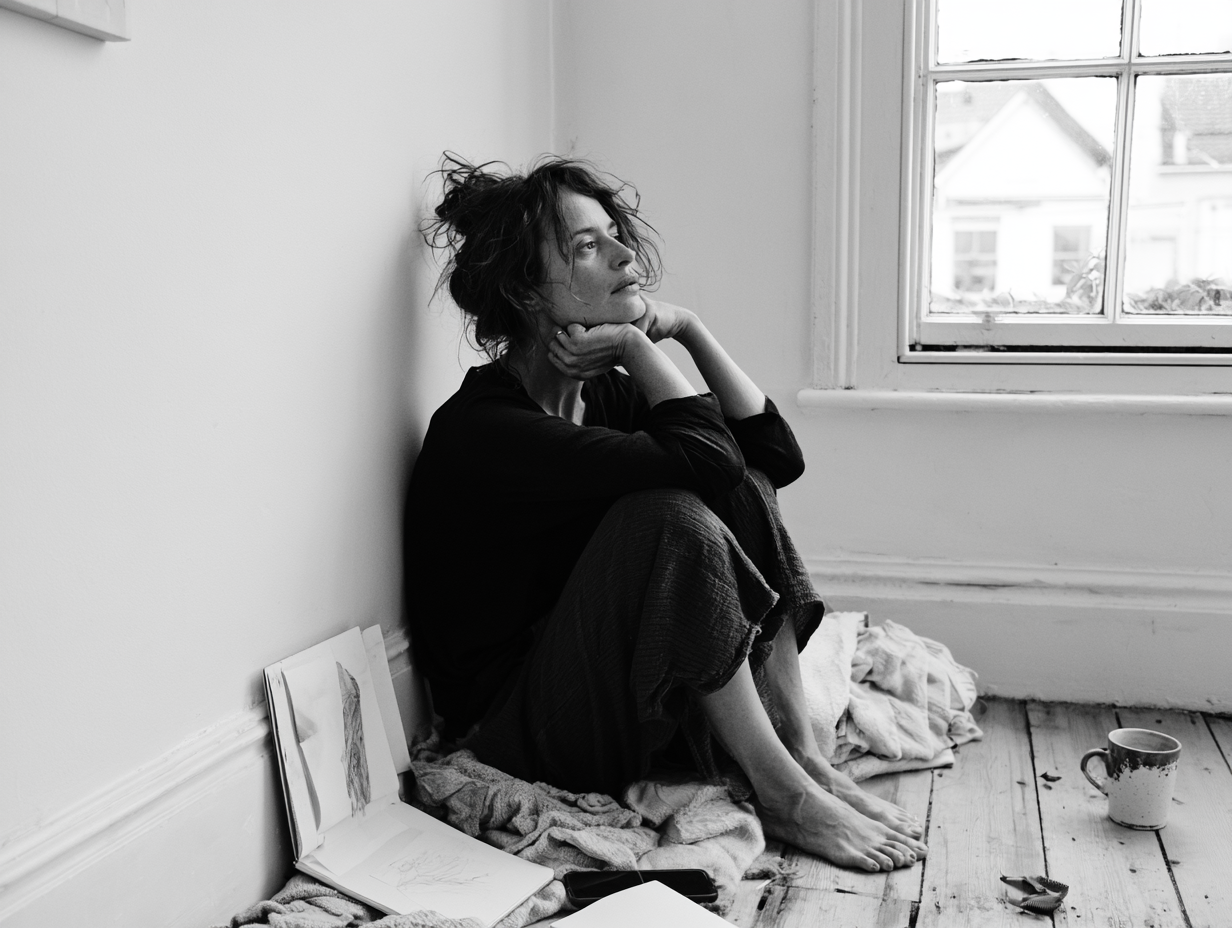
Creative Burnout: What It Is, Why It Happens, and How to Actually Recover
Creative burnout doesn't always look like exhaustion. Sometimes it looks like dread where there used to be play. Here's what actually causes it for multi-passionate people, how to spot it before it wrecks the thing you love, and how I found my way back to doing my creative work for the pleasure of it again.
Creative burnout doesn't usually arrive as exhaustion. It arrives as dread, a knot in your stomach, at the exact spot where butterflies or play used to be. You sit down to do the thing you love, the thing that used to feel like breathing room, that used to bring you to a place called flow, and instead of relief, you feel a tight, low-grade, nagging pressure to perform it correctly, on time, for an audience.
I'm Murielle Marie, career and business coach for multi-hyphenates and multi-passionate creatives (or creative generalists, like I like to say), and I know this one from the inside. I experience creative burnout regularly, especially around social media, and it's hard. Not the "I need a nap" kind of hard. The "I have genuinely lost the thread of why I'm doing this" kind of despair. Rings a bell?
What Creative Burnout Actually Is
Creative burnout is what happens when a creative practice, something that used to thrive on internal motivation, becomes an obligation. It's not the same as being tired, and it's not the same as running out of ideas. It's the specific exhaustion of doing something you love for reasons that no longer feel like your own, like writing because it’s your “job” or designing for a marketing campaign that goes against your values.
For me, it shows up as pressure that my inner rebel gets agitated by. Too many passions pulling at me at once, and underneath that, a subtle shift from "I want to" to "I have to." The moment creativity is commodified into content, a schedule, a number, that's exactly when it gets hard for me. It stops feeling like I have a choice - something I need to thrive and do my best work.
A recent Creative Boom survey of 882 creative professionals worldwide found I’m certainly not the only one: 69% had experienced burnout in the past 12 months, and mid-career creatives, the ones managing the most competing demands with the least authority to say no, reported the highest rate of all at 77%. Founders and studio leaders, who generally have more control over the shape of their own workload, fared better at 59%, still a majority, but a meaningfully smaller one. Control over your own pace, it turns out, is protective.
Why It Feels Especially Hard for Multi-Passionate People
If you're a creative generalist, someone with an inner rebel or activist streak who genuinely can't stand being told what to make and when, creative burnout doesn't just feel tiring. It feels oppressive. Like being folded into a box that's too tight, with no air and no way out.
That's precisely how it felt for me, like I had no freedom left in something that used to be the freest part of my day. And I think that's an important nuance most burnout advice misses: for a generalist, creative burnout isn't only about volume of output, it's about a loss of autonomy over something that was supposed to be free by nature.
There's real research on why commodifying a loved activity backfires in this specific case. The classic finding, first demonstrated by psychologist Edward Deci in 1971, is called the overjustification effect: people who genuinely enjoyed an activity lost interest in it once they were paid to do it, because the external reason overshadowed the internal one. A recent Big Think piece, drawn from a new book on creativity and choice, makes almost the same case from a different angle: treating passion as a fixed thing to protect and perform, rather than something developed through exploration and openness, is exactly what tips it into burnout. Once "I want to make this" becomes "I have to post this," the reward system underneath the whole activity is turned on its head. The result? We lose the desire to do it at all.
Signs It's Creative Burnout, Not Just a Slow Week
A slow creative week is common, and the good news is, it usually passes. Creative burnout tends to hang around, and it usually shows up as more than one of these at once:
Dread instead of relief when you sit down to do the thing you used to love
A tight, squeezing feeling, like there's no room to do it differently or not at all
Doing it for the deadline, the algorithm, or the audience, not because you actually want to in that moment
Resentment toward your own passions, especially if you have several pulling at you simultaneously
A drop in actual curiosity, not just energy. You stop wondering "what if" and start just executing
If two or three of these are true for you right now, you're not lazy, and you're not out of ideas. You're burned out because of the conditions around the work, not the work itself.
How I Actually Recovered
The shift for me wasn't a productivity fix, a different schedule, or trying yet another way to stick with it and “do it anyway.” It was realizing I had to give myself more room to breathe, to play before I could even think about the creative work again.
I had to go back to doing it for the pleasure of it, and not because of an arbitrary or external deadline or rule. That's the whole point. Not a new system, not a smarter schedule, just permission to let the activity be mine again instead of a performance for anyone else, including a future version of me with expectations.
A few things that actually helped, in case they're useful to you too:
Name the rule that isn't real. Most of the pressure that creates creative burnout is self-imposed. Ask yourself honestly who set the deadline, the frequency, the format. Often, no one did. Or, rather, YOU did. You're allowed to un-set it.
Make something with zero audience. Not a draft of something you'll eventually post. Something that’s just for you and is never seen by anyone else. This is usually the fastest way back to remembering why you started.
Separate the passion from the platform. Social media specifically has a way of turning play into performance. If a passion only feels heavy on the platform and light everywhere else, that's information. Follow it and free yourself from the burden.
Let "I have to" go unanswered for a while. Don’t give in to the "I have to-s" for a while. Often the pressure loosens on its own once it's not being fed.
None of this is about giving up, caring less, or letting go of your passions. It's about caring in a way that isn't slowly grinding the thing you love into something you resent.
Common Questions About Creative Burnout
What causes creative burnout?
Creative burnout is usually caused by a shift in motivation, when a creative activity that used to thrive on internal desire starts running on external pressure instead: a deadline, an audience, an algorithm, or a self-imposed rule. Volume of output matters less than whether the activity still feels like your own choice.
How is creative burnout different from regular burnout?
Regular burnout is typically tied to workload and exhaustion. Creative burnout can happen even when output is low because the core issue isn't how much you're doing; it's whether what you're doing still feels like play or has become an obligation.
How long does creative burnout last?
It depends entirely on whether the underlying pressure gets addressed, not just paused. A short break can temporarily restore energy, but if you return to the exact same "have to" conditions, the burnout tends to come right back. Real recovery usually means changing your relationship to the deadline, audience, or rule that caused it in the first place.
Can you be creative and still be burned out?
Yes, and this is one of the more confusing parts of creative burnout. You can still technically produce work while burned out, it just costs far more than it used to, and it stops feeling like anything close to play. The output continuing doesn't mean the burnout isn't real.
Ready to find your way back to making things for the love of it?
If your creative practice has started to feel like one more thing you have to perform, you're not broken, and you haven't lost your spark; you've just lost the freedom around it. That freedom is recoverable, but it usually takes more than "taking a break" to actually get it back.
Book a free 20-minute coaching call, and let's untangle which of your rules are real and which ones you quietly made up, so you can do the work you love because you want to, not because you have to.